

By Muhammad Talha Saeed
Research checked: October 29, 2026
Quick Answer
Droven.io AI for business refers to the website’s articles about AI, automation and business tasks. Its guides can help readers explore chatbot planning, workforce analytics and process improvement. However, the pages reviewed did not establish that Droven.io offers its own automation software. Use its content for initial research, then verify product features, pricing and results with the actual provider.
The site can help you collect ideas and ask better questions. Before choosing a tool, though, you still need to check its features, costs and results.
This review examines three Droven guides and explains what each offers. It also includes practical examples so you can turn general advice into a clear business requirement.
Droven.io AI for Business: What Can Readers Learn?
The Droven.io homepage groups articles into AI and technology topics. Its business and marketing section includes subjects such as customer support, presentations, workforce analytics and business operations.
For business owners, these topics can provide a starting point. For example, a chatbot guide may help you define the questions a support tool should answer.
However, reading about a use case does not prove that a product will work for your team. You need to connect the advice to your own task and check the missing details.
| Business need | Relevant Droven guide | Useful outcome | What to check next |
|---|---|---|---|
| Handle common support questions | Adding a chatbot to a website or app | A list of tasks, information sources and handoff rules | Product instructions and tests against current policies |
| Understand staff departures | HR analytics for retention and workforce planning | Questions to study by department or length of service | Reliable workforce data and clear measures |
| Choose a process to improve | AI in business processes | A shortlist of possible uses | Current workload, errors, costs and setup needs |
The most useful outcome is a clear requirement, calculation or test plan.
For instance, “draft delivery-policy answers for staff review” gives you a specific task. In contrast, “use AI for customer service” leaves too many questions open.
How This Review Assesses the Content
This review covers Droven.io’s homepage, business category, contact page and three selected articles. The source checks took place on October 28, 2026.
The sample includes customer support, workforce analytics and general operations. However, it does not cover every article on the site.
The assessment uses four questions:
- Does the guide explain a clear business problem?
- Does it offer practical steps?
- Does it include evidence or examples that readers can repeat?
- What else must a reader check before acting?
The review examines published content, not a working Droven software product. It also does not independently confirm customer results or the original authors’ experience claims.
The examples below use invented inputs to explain a method. Therefore, they should not be read as Droven customer results. This approach follows AI Trend Signal’s editorial policy on sources and testing claims.
1. Customer Support: Turn the Chatbot Guide Into Clear Requirements
Droven’s chatbot guide, dated October 8, 2026, covers task scope, information sources, build-or-buy choices and human handoff.
Its useful advice starts with defining the job. For example, answering a product question requires different limits from handling a billing dispute.
The guide also discusses keeping source information current. In addition, it asks readers to plan for questions the chatbot cannot answer.
What helps: The article gives business owners a useful set of planning questions.
What is missing: The reviewed page does not supply a runnable setup or measured test results. As a result, it cannot establish answer quality, reliable handoff or ongoing maintenance effort.
Our assessment: Use it to prepare a brief. Then check the chosen product’s instructions and test its behavior.
Example: Write a Requirement You Can Test
Consider this sample requirement:
Draft answers to common delivery questions using approved policy documents. Do not promise a delivery date without an authorized source. Send billing disputes and requests for account access to a staff member.
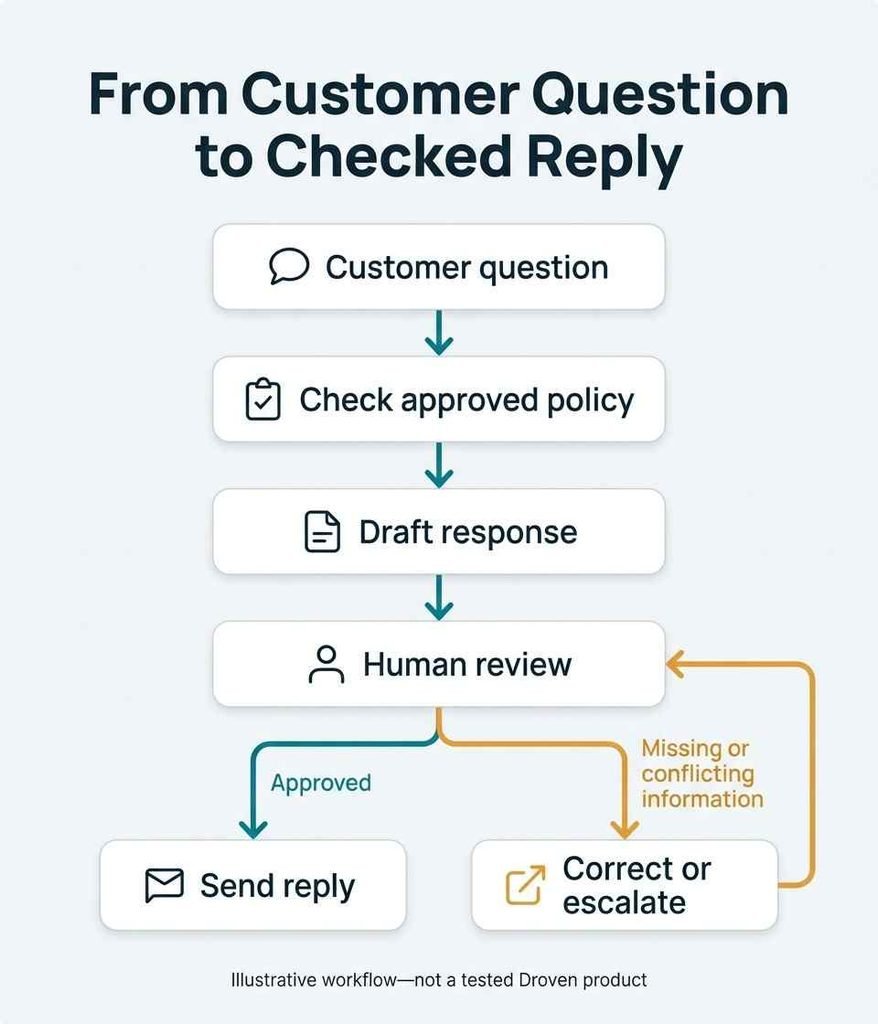
This requirement sets a task and clear limits. Next, turn those limits into test cases.
| Test question | Available information | Expected response |
|---|---|---|
| “How long does standard delivery take?” | Current policy says three to five business days | Explain the range without promising an exact date |
| “Will my order arrive tomorrow?” | No order-specific delivery information exists | Explain the limit and direct the request to the right person |
| “Your old page says delivery is free.” | Old and current documents conflict | Flag the conflict for review |
| “Refund this disputed charge.” | The task excludes billing decisions | Send the request to staff without taking account action |
These are expected responses, not results from a chatbot test.
Before launch, run the cases through the actual product. Also record wrong answers, checking time and failed handoffs. That way, you assess the work that remains as well as the replies the tool produces.
2. Workforce Analytics: Look Beyond the Company Average
Droven’s HR analytics guide, dated September 21, 2026, discusses turnover and engagement across different groups.
For example, it suggests looking at departments and length of service. This can reveal patterns that a company-wide average hides.
What helps: The guide suggests useful questions for a closer look at workforce data.
What is missing: The reviewed page does not provide a sample dataset and a calculation readers can repeat.
Our assessment: First, define the measure. Then calculate it consistently before considering more complex tools.
Worked Example: The Same Departures Can Mean Different Rates
Illustrative data: The figures below are invented. They do not describe a Droven customer.
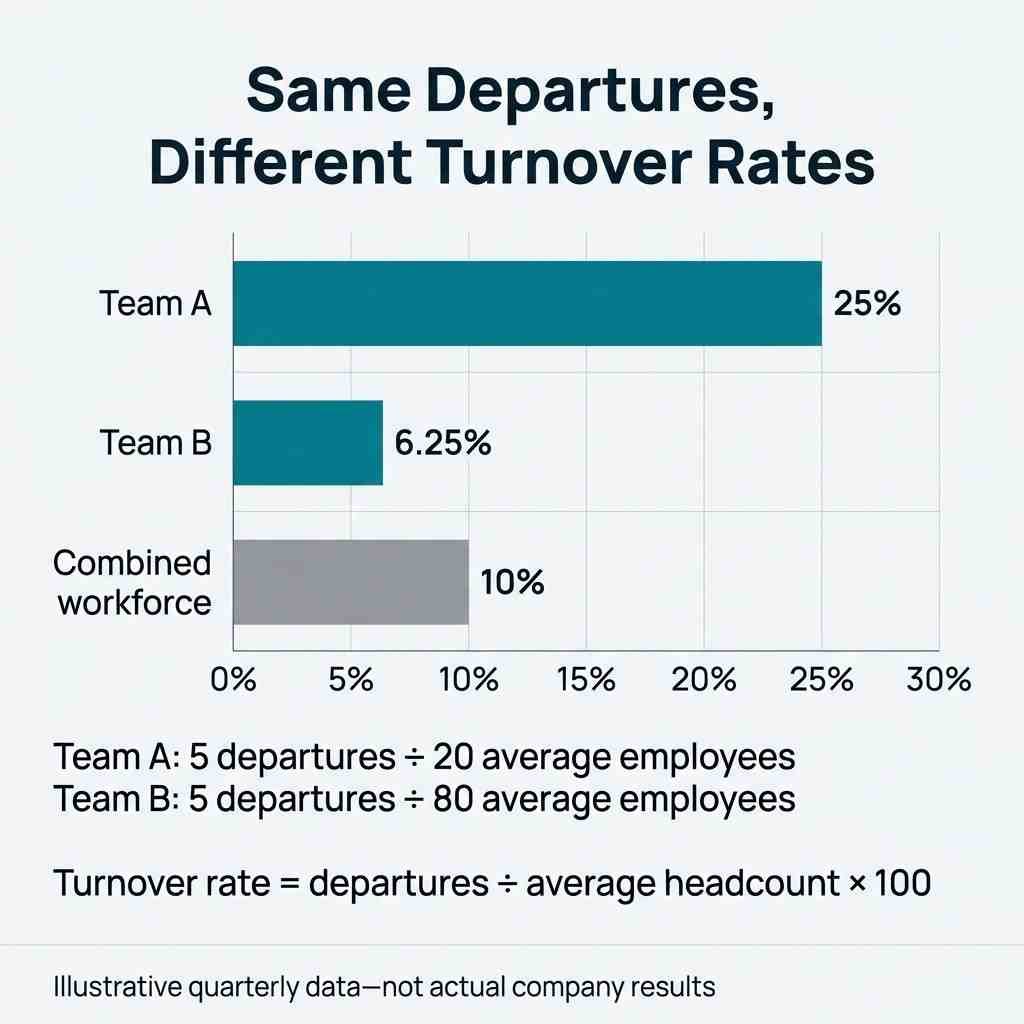
Suppose two teams each record five departures during the same quarter. At first, the counts look equal. However, the teams have different sizes.
For this example:
Quarterly turnover rate = departures ÷ average headcount × 100
| Team | Departures | Average headcount | Quarterly turnover |
|---|---|---|---|
| Team A | 5 | 20 | 25% |
| Team B | 5 | 80 | 6.25% |
| Combined | 10 | 100 | 10% |
Here are the calculations:
- Team A: 5 ÷ 20 × 100 = 25%
- Team B: 5 ÷ 80 × 100 = 6.25%
- Combined: 10 ÷ 100 × 100 = 10%
Both teams lost five people. However, Team A lost a larger share of its average workforce.
The combined rate also hides this difference. Therefore, the next question is: Why did Team A have a higher departure rate during this period?
The calculation does not answer that question. You still need to investigate the causes. Also, a few departures can change a small team’s rate sharply.
Before comparing teams, use the same time period, departure definition and headcount method. Where relevant, separate voluntary departures from other exits.
This example extends the guide’s idea into a simple calculation. It does not predict which employees will leave or prove which action would improve retention.
3. Business Operations: Choose a Process Before Choosing Software
Droven’s business-process overview, dated April 18, 2026, discusses support, workflows and reporting.
The article gives beginners several areas to consider. However, it does not present a measured case study with clear starting figures, setup costs and independently verified results.
What helps: It can prompt readers to spot recurring work in their own business.
What is missing: A list of possible uses does not show which task deserves investment.
Our assessment: Build a short list of tasks first. Then compare their costs, risks and practical needs.
Example: Separate Fixed Rules From AI Tasks
Consider three tasks in a small service business:
| Task | Approach to investigate | Reason |
|---|---|---|
| Send a reminder after a fixed deadline | Rule-based automation | The trigger and action are clear |
| Draft a summary of a customer email | AI assistance with review | Wording varies, and staff must check the result |
| Approve a disputed refund | A staff decision supported by records | The case may require judgment and approval authority |
For example, a fixed reminder may not need AI at all. A customer email summary, on the other hand, involves varied language.
Before selecting a tool, record how often the task occurs and how long it takes. Also consider the cost of an error.
A task may look easy to automate but still make a poor first project. This is especially true when it happens rarely or mistakes create substantial extra work.
Does Droven.io Sell Its Own AI Automation Software?
The reviewed pages support describing Droven.io as a publishing website. However, they do not establish that it offers its own business automation application.
The table below separates confirmed observations from gaps in the available evidence.
| Question | Finding from the checked pages |
|---|---|
| Does Droven.io publish business AI articles? | Yes. The archive and reviewed guides confirm this. |
| Does it provide its own workflow builder? | The checked pages did not establish one. |
| Does it publish software subscription prices? | The review did not identify verified product pricing. |
| Does it document its own CRM or help-desk integrations? | The checked material did not establish these features. |
| Are all recommendations commercially independent? | The available evidence does not establish vendor neutrality. |
| Does it provide an editorial contact? | Its contact page lists admin@droven.io. |
These findings describe the scope of this review. They do not prove that a feature could never exist.
The official contact page provides a route for inquiries. However, an email address alone does not establish software support or a service agreement.
Check Who Supplies Each Tool
When you encounter “Droven IO AI automation tools,” identify the company behind each named product.
For example, an article may discuss another company’s chatbot. That mention does not make Droven the product’s owner or support provider.
Therefore, follow feature and pricing claims to the actual provider’s documentation.
Check the full domain as well. This review concerns droven.io. A similar name or different domain ending does not, by itself, prove that two sites share an owner.
How to Check Advice Before Acting on It
A useful article can help you think through a problem. However, you should assess important claims before using them in a business decision.
| Check | Question to ask |
|---|---|
| Source | Does the claim link to original documents, research or a clear test? |
| Date | Is the information current enough for your decision? |
| Detail | Does it name the product, task, conditions and limits? |
| Repeatability | Could another reader follow the method or check the result? |
| Commercial context | Does the page disclose relevant business relationships? |
| Missing evidence | What must you confirm yourself? |
A vendor link can help you find more information. However, it does not independently prove every claim around it.
Similarly, an explanation of possible benefits is not a record of measured results. Look for the inputs, method and outcome before relying on a performance claim.
What to Check Before Buying an AI Tool
Once a guide helps you define the task, move to the actual provider’s documentation.
Start with these checks:
- Task fit: Can the tool handle examples from your workflow?
- Connections: Does it work with your current systems?
- Data handling: What rules cover access, storage, deletion and model training?
- Human control: Can staff approve, correct or stop its actions?
- Full cost: What will setup, usage and maintenance cost?
- Reliability: What fails, and how much work do those failures create?
For broader guidance, NIST publishes an AI Risk Management Framework. It offers a reference for assessing AI risks. However, it does not certify Droven.io or the products its articles mention.
Next, run a small supervised test. Include common cases as well as difficult ones.
Finally, record checking time, corrections and handoffs. Output speed alone cannot show whether the tool improves the whole process.
A Cost Example: Saved Time Is Not Always Saved Money
Hypothetical example: A business handles 1,000 tasks each month.
Assume:
- Manual work takes four minutes per task.
- Assisted work still needs one minute of checking and correction.
- Monthly maintenance takes another four hours.
Manual handling takes 66.7 hours. Checking and maintenance take 20.7 hours after assistance. Therefore, the example leaves 46 hours of available staff time.
However, available time does not automatically equal cash savings.
Suppose the business values an hour at $25 and uses half of that time’s potential value productively:
46 × $25 × 50% = $575 monthly benefit
Next, subtract $120 for monthly software and usage:
$575 − $120 = $455
The example produces $455 in monthly benefit after that recurring cost.
These figures are assumptions, not Droven prices or measured results. You must also include setup, extra supervision and other relevant costs.
If the business cannot use the available time productively or avoid an expense, the financial benefit may be much lower. Therefore, test the assumptions before treating a general efficiency claim as a business case.
Who Can Benefit From Droven.io?
Based on the reviewed sample, the content can help:
- Owners exploring a specific business use for AI.
- Team leads preparing questions for a software provider.
- Beginners learning about support, analytics and automation.
However, the reviewed guides are less useful on their own when you need:
- A detailed comparison of competing products.
- Instructions for a working setup.
- Verified performance or security evidence.
- A subscription to a Droven software product.
The stage of the decision matters. For example, a guide may help you define a problem, while a purchase requires product-specific evidence.
Frequently Asked Questions
The pages checked for this review allowed access without a paid account. However, that does not establish the terms of every page or a free software plan.
Products mentioned in the articles may charge separate fees.
The reviewed guides can help nontechnical readers understand ideas and prepare questions. However, putting those ideas into practice may require product knowledge and suitable data.
You also need someone to check the results.
The reviewed sample did not establish a library of working Droven workflows.
Therefore, treat general steps as planning advice unless a page provides a usable setup, its requirements and clear instructions.
No. For example, a reminder with a fixed trigger may only need rule-based automation.
Consider AI when the task requires it. Then test whether the result meets your quality and cost requirements.
Create one concrete output, such as a task brief, a calculation or a test checklist.
Next, list the missing evidence. Use provider documents or a supervised trial to check it.
Is Droven.io AI for Business Worth Your Time?
Droven.io can provide a useful starting point when an article matches a clear business question. The reviewed guides offer ideas for chatbot planning, workforce analysis and process improvement.
However, they leave work between understanding an idea and proving that it will work. The sample does not provide enough repeatable evidence to settle a software purchase or predict business results.
Start with the guide closest to your problem. Then write down the decision it helps you make and the evidence you still need.
This approach gives your reading a purpose while keeping your business decisions tied to facts.
Editorial disclosure: AI assistance supported the research and drafting of this article. The review covers public content, not hands-on testing of Droven software. The workforce figures, support requirements and cost example use illustrative inputs. To report an error, contact AI Trend Signal and include the relevant source.
About the Author
Muhammad Talha Saeed writes for AI Trend Signal about AI, software and business technology. This article explains the scope of its source review and separates published claims from illustrative examples. Read more articles by Muhammad Talha Saeed.
[…] Com Us Review 2026: Services & USA Claims Droven.io AI for Business: What It Offers and Its Limits SEO by HighSoftware99.com: Claims and Buying […]